Unclear priorities
Too many possible use cases make it difficult to know where to begin.

Identify the workflow, capability or organisational constraint preventing your department from using AI safely and productively, and leave with a sequenced 90 day plan.
Discuss the AI Bottleneck AuditMany performance and medical teams know AI could improve their work, but lack clarity on where it belongs, what to prioritise and what they can safely trust. The right starting point is diagnosis, not technology.
David has studied with London Business School, London Interdisciplinary School, HEC Paris, and the University of Chicago Booth School of Business MasterClass Executive in collaboration with OpenAI. He is also part of the Alliance Mastermind with Steven Kotler on abundance, AI and exponential technologies.
Too many possible use cases make it difficult to know where to begin.
Important work is spread across disconnected systems, handovers and informal processes.
Generic tools and use cases fail to reflect how the department actually operates.
Responsibility for evaluation, implementation and adoption is not clearly assigned.
Teams need confidence about safe use, professional standards and appropriate oversight
Separate high-value, low-risk opportunities from tools and ideas that should be deferred.
Map recurring work to understand where AI should support people, complete work automatically or strengthen professional capability.
Identify which tasks sit within AI’s reliable capabilities, which sit outside them and which require a human reviewer.
Protect the decisions, responsibilities and areas of professional judgement that must remain human led.

Designed for organisations that want to understand where AI can create meaningful value, while bringing leadership, performance, medical and cross-functional teams around a clear path forward.

Set clear AI priorities, align your people and build a practical path from ambition to action.

Identify where AI can streamline workflows, connect performance insights and support better decisions.

Explore AI opportunities in medical workflows while keeping clinical judgement, privacy and accountability central.

Connect expertise, improve knowledge flow and build shared ways of working with AI across departments.
Establish the stakes, pain, urgency and authority. Outcome: Decide whether a genuine bottleneck exists.
Identify the highest leverage organisational, workflow, leadership or capability constraint. Deliverable: AI Bottleneck Dossier.
Redesign and test the priority workflows identified through the audit. Outcome: Working pilots, governance and adoption.
Embed and expand the system over time. Outcome: An ongoing AI native operating model.
The primary organisational, workflow, leadership or capability bottleneck slowing adoption.
Recurring work mapped across Assist, Automate, Augment and Human Only.
Tasks identified as inside the reliable AI frontier, outside it or requiring a reviewer.
Where the current system is losing time, attention, consistency, knowledge or decision quality.
Three high value, low risk workflows to test.
What should happen first, second and third, with owners and success measures.
Tools, use cases and investments the department should deliberately defer.
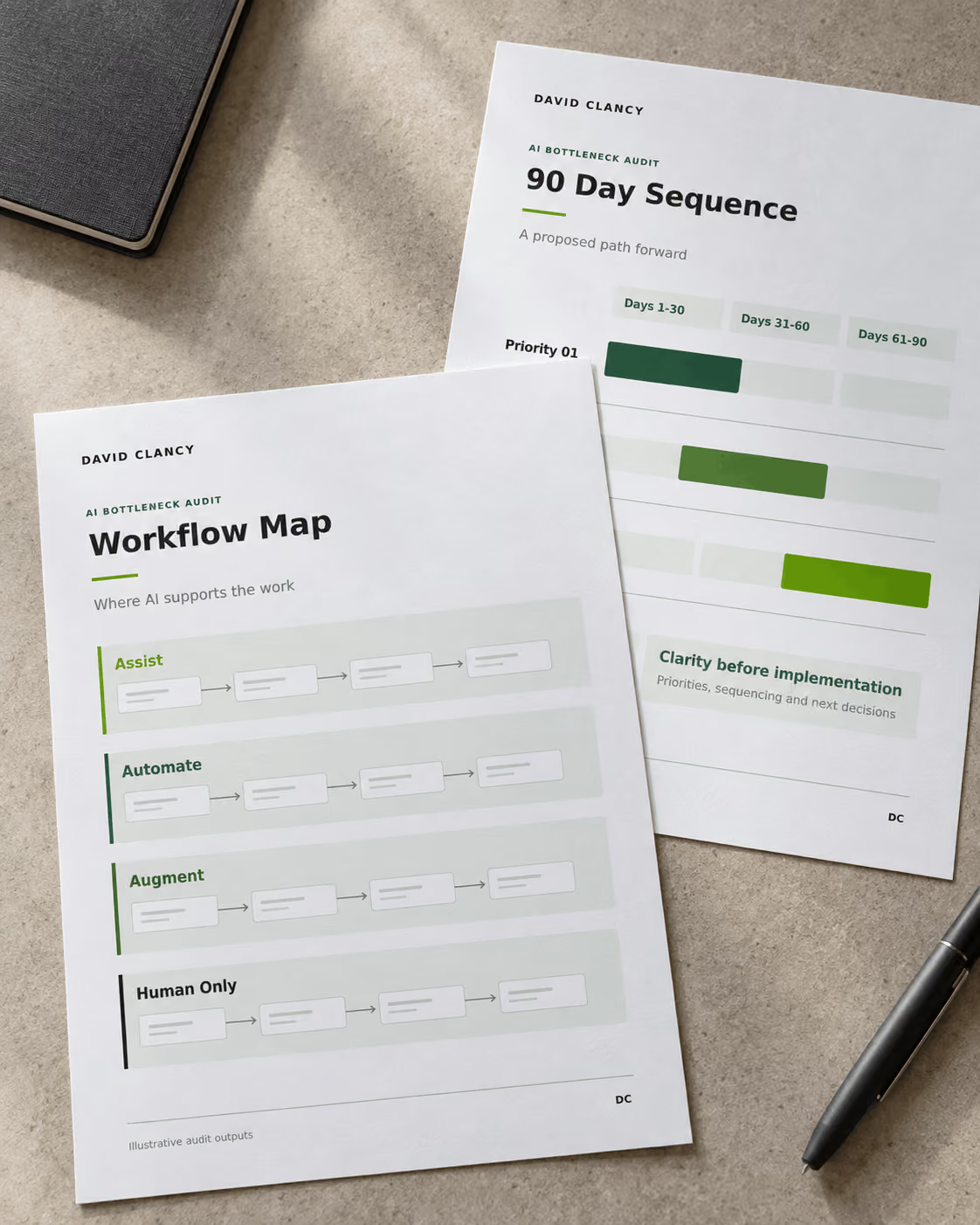

The AI Bottleneck Audit is designed to create clarity before any implementation decision. The 90 Day Implementation Sprint and ongoing Strategic Advisory are separately scoped based on the priorities identified through the audit.
Discuss the AI Bottleneck AuditThe 3 Hour 5 Cs and AI Workshop gives leadership teams a focused space to explore organisational readiness, discuss opportunities and establish practical next steps.